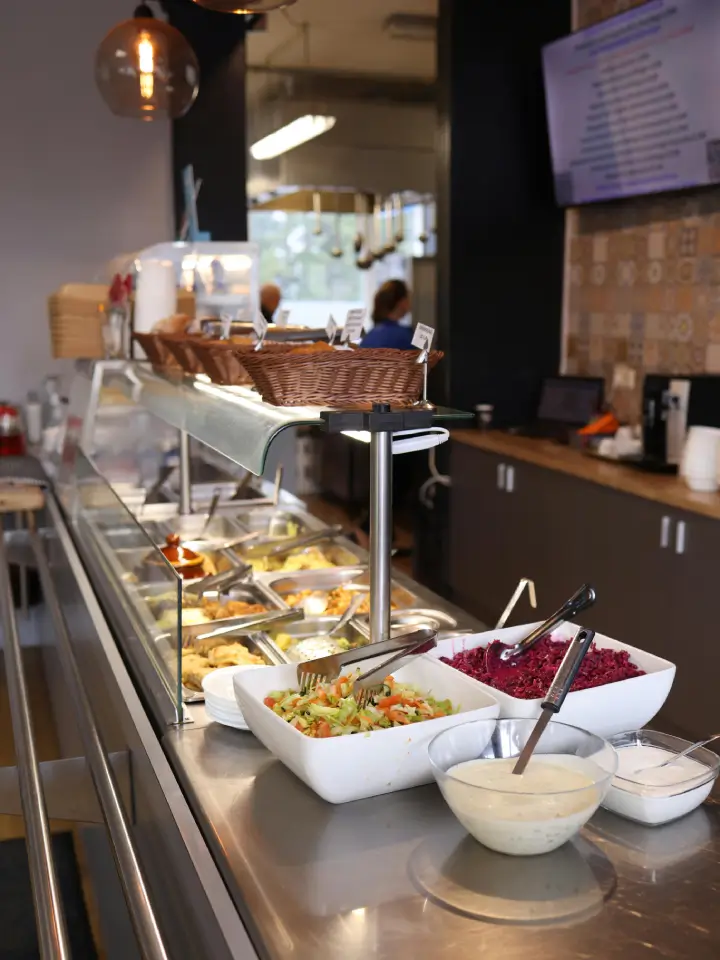

A prospective student opens their laptop on a Sunday night. They’ve narrowed their college list to five schools. Before scheduling campus tours, before filling out applications, they do what Gen Z does instinctively: they search. Not for acceptance rates or endowment figures — for something far more immediate. What will I eat every day for four years?
That search lands them on a buried page three clicks deep into the university’s main website. The page hasn’t been updated since the fall semester. The menu is a PDF from October. The photos are generic stock images of smiling students holding salads that look nothing like actual dining hall food. The student closes the tab and moves on.
This scenario plays out thousands of times a week across American higher education. Campus dining programs — responsible for millions of dollars in revenue, student satisfaction scores, and institutional reputation — are operating with a digital presence that would embarrass a local restaurant. A single page, nested inside an immeasurably larger university site, controlled by someone in IT who has forty other departments to support.
It doesn’t have to be this way. Your dining program deserves a dedicated, branded website — and the reasons go far deeper than aesthetics.
The First Impression Problem
The modern college search process is profoundly digital. According to Ruffalo Noel Levitz’s E-Expectations Report, the majority of prospective students and parents visit a campus dining page before making enrollment decisions. Dining isn’t a footnote — it’s a deciding factor. For students with dietary restrictions, food allergies, or specific cultural and religious requirements, it may be the deciding factor.
Yet most campus dining pages exist as an afterthought within the university’s primary web property. They’re limited to whatever template the web team provides, updated on the web team’s schedule, and designed to fit the university’s brand voice rather than the dining program’s unique identity.
This creates a fundamental mismatch. A university website is built to serve dozens of audiences: prospective students, current students, faculty, staff, alumni, donors, media, and community members. Every page must navigate institutional priorities, committee-driven design, and centralized content governance. Your dining program is just one more node in that system — and usually not a high-priority one.
A standalone dining website flips the equation. Instead of being a small part of someone else’s digital ecosystem, your dining program becomes the center of its own. Every page, every image, every piece of content exists to serve one audience: the students and families who want to understand what campus dining looks, feels, and tastes like.
What a Dedicated Dining Website Actually Solves
Control Over the Narrative
When dining lives on the university’s main site, your communications team — if you even have one — is at the mercy of the central web team’s timeline. Want to update the menu for spring semester? Submit a ticket. Need to promote a new allergen-friendly station? Wait for the next content review cycle. Want to feature your sustainability initiatives during Earth Week? Hope the web team has bandwidth.
A dedicated site puts the editorial calendar in dining’s hands. Your team can publish when it matters — not when IT gets to it. Seasonal menus go live on time. Special events are promoted the week they happen, not three weeks later. When a dining director spots a great photo from last night’s themed dinner, it can be on the homepage within the hour.
This isn’t about bypassing institutional oversight. It’s about operational agility. Dining programs move fast: menus change weekly, staffing shifts seasonally, and student preferences evolve constantly. Your digital presence needs to keep pace.
Space to Tell the Full Story
A university page template gives you one page, maybe two. That’s not enough room to communicate the depth of a modern campus dining operation. You’re managing multiple venues, each with distinct concepts and menus. You’re sourcing locally, accommodating allergies, running sustainability programs, and training culinary teams. You’re managing a multi-million-dollar operation that touches every student on campus every single day.
A dedicated website lets you create dedicated pages for:
- Individual dining locations with their own hours, menus, atmospheres, and photos
- Allergen and dietary resources that go beyond a one-line disclaimer to actually help students navigate their options
- Sustainability and sourcing stories that showcase your farm-to-table partnerships, food waste reduction, and composting programs
- Staff spotlights that humanize the people behind the serving line
- Events and themed dinners that drive excitement and engagement
- Nutrition and wellness content that supports student health
Each of these is a page that deserves space, attention, and regular updates. Cramming them into a single university-branded page is like asking a restaurant to operate with a menu the size of a business card.
SEO That Actually Works
Here’s a technical reality that most dining teams don’t consider: search engine optimization for a nested page is fundamentally harder than for a dedicated site. When your dining content lives at university.edu/campus-life/dining/, you’re competing with the entire university domain for search authority on dining-related queries.
Not all fixes are equal, either. There are three common setups, and they aren’t interchangeable:
- A buried subpage (
university.edu/campus-life/dining/) — nested in the university’s information architecture, gated by the same IT team and content review cycle as every other department. - A subdomain (
dining.university.edu) — gives the dining team its own CMS and publishing control, a real improvement. But it’s still read by both Google and visitors as part of the parent .edu domain, so it doesn’t fully escape the university’s brand voice or SEO gravity. - A dedicated domain (its own
.com) — fully independent site, sitemap, and brand identity. This is what lets a dining program rank on its own for terms like “best campus dining [your city]” or “vegan-friendly college dining,” rather than sharing search authority with admissions, athletics, and every other department on the university’s domain.
When a parent searches “does [your university] have gluten-free options,” a well-optimized standalone site will surface that answer directly, rather than burying it three levels deep in the university’s information architecture.
This matters for enrollment. The National Association of College and University Food Services (NACUFS) reports that dining quality is consistently ranked among the top factors in campus visit decisions. If your dining program can’t be found easily, it might as well not exist in the consideration set.
Brand Identity That Resonates
Your dining program has its own brand — even if you haven’t formally articulated it. The way your chefs present food, the atmosphere of your dining halls, the names of your retail concepts, the local farms you partner with — all of these create a distinct identity that’s different from the university’s institutional brand.
A standalone website lets you express that identity authentically. You can use food photography and design that evokes warmth and appetite, rather than the clean but sterile aesthetic of a university template. You can write in a voice that speaks directly to students, rather than the third-person institutional tone that university style guides typically enforce.
Look at how independent restaurants and hospitality brands approach their web presence. They lead with imagery. They tell stories about ingredients and people. They create an emotional connection before the customer ever walks through the door. Your dining program can do the same — but only if you have the digital real estate to do it.
The Technology Gap
Despite the clear need, most dining teams lack the technical resources to build and maintain a standalone website. University IT teams are stretched thin. Web agencies are expensive. Most dining operations don’t have a web developer on staff.
This is where the right technology platform changes everything. What dining teams need is a website they can actually control — a system where the dining team can create, edit, and publish content directly without developer dependencies.
Visual, drag-and-drop content management is the key. When a dining manager can log in, see a visual representation of their site, drag a new menu block into place, upload a photo from their phone, and hit publish — that’s when the website becomes a living communication tool rather than a static brochure.
Modern frameworks like Next.js make this technically feasible. They deliver the fast load times, mobile responsiveness, and SEO performance that today’s web demands, while supporting the flexible content architecture that dining programs need. But the framework alone isn’t enough — it needs to be paired with a content management experience that non-technical staff can actually use.
What “Good” Looks Like
Imagine a dining website where menus update in real time, each location has its own page with photos and dietary info, the homepage changes with the seasons, and the dining team manages everything directly — no IT tickets, no two-week turnaround.
This isn’t aspirational. This is what modern web technology enables.
The Competitive Reality
Higher education is increasingly competitive. Enrollment declines are well documented, and institutions are fighting harder than ever to attract and retain students. Dining has emerged as a differentiator in that fight.
Schools like Virginia Tech and University of Massachusetts Amherst — a past NACUFS award winner — have invested in dedicated dining web presences — and they feature those prominently in recruitment materials. When a prospective student compares two schools and finds one with a polished, informative, up-to-date dining website and the other with a stale PDF, the perception gap is immediate.
Your dining program may already be excellent. The food may be outstanding. The staff may be world-class. But if your digital presence doesn’t reflect that quality, prospective students and their families will never know. And in a world where the first impression happens online, that gap between reality and perception is a problem you can’t afford.
Making the Case
If you’re a dining director, you probably already agree. The challenge is convincing institutional leadership. Here’s the case:
-
It’s a recruitment tool. Dining content directly influences enrollment decisions. A dedicated website is a direct investment in your institution’s ability to attract students.
-
It reduces support burden. When students can find hours, menus, and dietary information on a well-organized site, they stop calling the dining office to ask.
-
It improves student satisfaction. Students who can easily discover dining options, check menus, and find accommodations for their dietary needs are more satisfied with their dining experience.
-
It’s operationally efficient. A CMS-controlled site means your team updates content directly, without waiting on IT or web services.
-
It supports retention. Current students use the site too. A great digital experience reinforces their connection to campus dining — and by extension, to the institution.
The investment required is modest compared to the return. Modern website platforms have eliminated the need for custom development. The ongoing cost of a managed, CMS-driven site is a fraction of what institutions spend on other recruitment and retention tools.
The Bottom Line
Your dining program touches every student on your campus. It’s one of the few services that students interact with multiple times every day. It shapes their daily experience, their health, their social connections, and their overall satisfaction with their college choice.
It deserves more than a buried page on the university website. It deserves its own digital home — a space that reflects the quality of your operation, serves the needs of your students and their families, and gives your team the tools to communicate effectively.
That’s exactly what Dining Connect builds. Our platform provides campus dining programs with dedicated, branded websites powered by Next.js, featuring a visual drag-and-drop CMS page builder that dining staff control directly — no IT tickets, no developer dependencies. Your team manages the content; we handle the technology. The result is a fast, beautiful dining website that makes the right first impression for prospective students and serves your campus community every day.